

Quick Answer Block
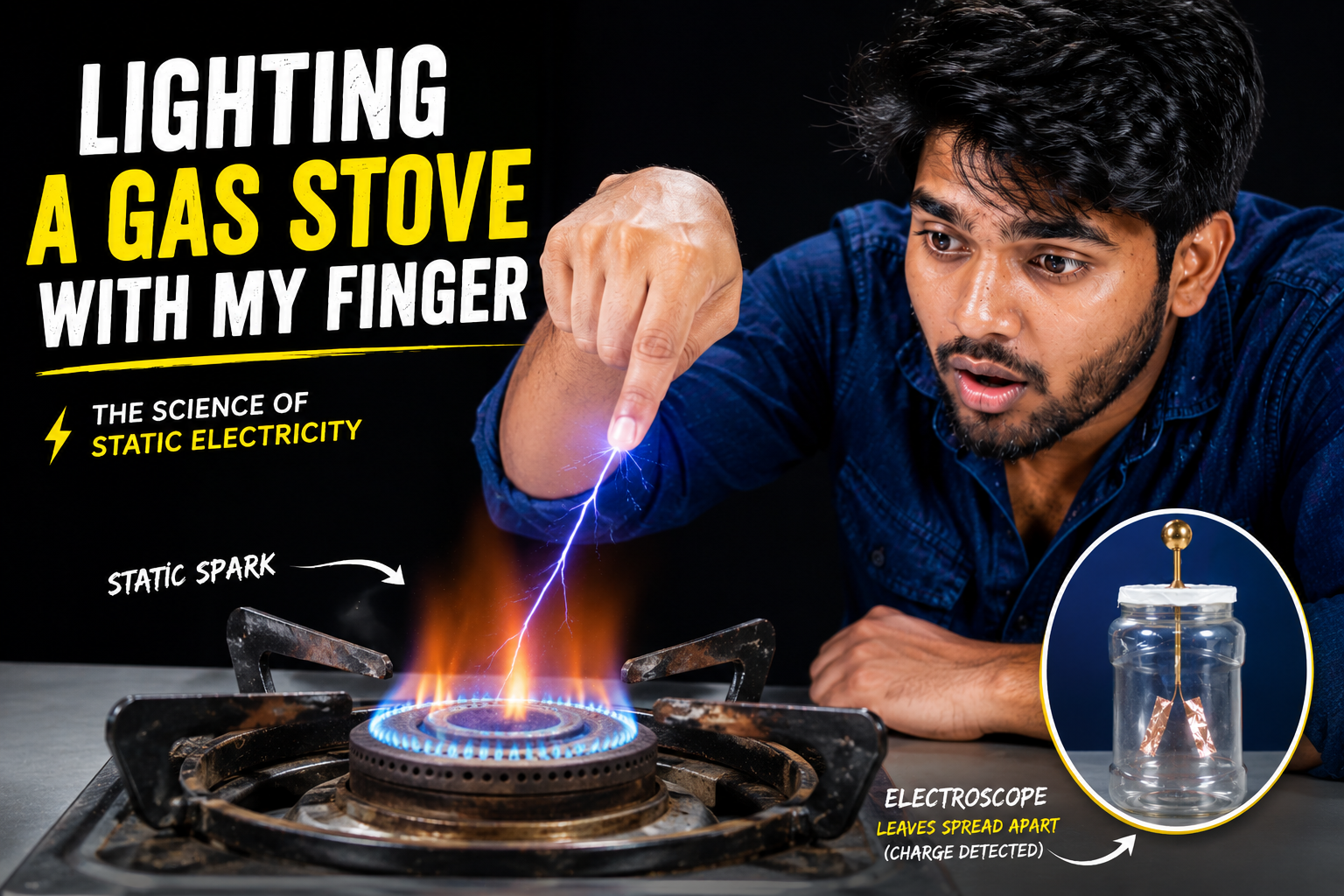
An electroscope is a simple scientific instrument that detects whether an object carries an electric charge, using the principle that like charges repel each other. When a charged object touches its knob, electrons either flow in or out of two thin conducting leaves inside, causing them to gain the same charge and visibly separate. The same charge-transfer principle explains how rubbing against certain fabrics can build up enough static charge to spark and even ignite a gas stove.
Introduction
is it’s really possible to light a gas stove without a match or a lighter — just using your finger. It sounds like a magic trick, but it’s genuine physics, and once you understand how it works, you’ll never look at static shocks the same way again.


Here’s the setup: sit on a plastic chair, rub a polyester cloth against yourself for a while, then bring your finger close to a gas stove’s burner. A visible spark jumps from your fingertip — and it’s hot enough to ignite the gas. The secret behind this trick is an instrument called the electroscope, a device built specifically to detect static electric charge. In this article, we’ll build up from how an electroscope works, through the two main ways charge transfers between objects, and finally explain exactly how a simple static shock can start a fire — including why that’s something to take seriously, not just show off.
What Is Combustion, and What Does a Gas Stove Need to Ignite?


Before we get to sparks and charges, it helps to understand what’s actually needed to make a gas stove light up in the first place. This process is called combustion, and it needs exactly three things: fuel, oxygen, and heat. A gas stove connected to an LPG cylinder already has flammable fuel — typically butane and propane — and the stove’s design includes small holes that let in oxygen from the surrounding air. That leaves only one missing ingredient: heat.
A standard match stick can produce roughly 800°C, easily enough to ignite LPG, which typically needs somewhere between 410°C and 580°C to combust. A lighter’s spark works the same way, producing heat in the 800°C to 1000°C range — more than enough to trigger the same combustion process, just without a flame already present.
What Is an Electroscope?
An electroscope is a scientific instrument used to detect whether an object carries an electric charge. It was first invented in 1600 by British physician William Gilbert, and it works on a principle you may already know: like charges repel each other.
Most electroscopes are built using conducting metals, since these materials allow charge to move freely through them. A simple electroscope typically consists of two thin metal leaves in contact with each other, connected to a metal rod that leads up to an external knob. When a charged object touches that knob, electrons either flow into the leaves or flow out of them — either way, both leaves end up carrying the same type of charge. Since like charges repel, the two leaves push apart and visibly separate, giving a clear signal that a charge is present.


From Simple Electroscope to Gold Leaf Electroscope
An upgraded version of this basic design is the gold leaf electroscope, developed in 1787 by British scientist Abraham Bennet. Gold and silver are used here specifically because they conduct charge exceptionally well.
In a gold leaf electroscope, a thin gold leaf is connected to a metal rod (often made of brass), which runs up to a knob at the top of a sealed glass jar. A graduated scale is often included alongside the leaf, letting you read the “degree of deflection” — essentially, how far apart the leaf spreads — as a rough measure of how strongly charged the object being tested is.
Charging by Friction vs Charging by Conduction
Charge doesn’t appear out of nowhere — it moves from one object to another, a process called charging. There are two distinct ways this can happen, and it’s worth being clear on the difference.
Charging by friction happens when two different materials are rubbed against each other, causing electrons to transfer from one to the other. A classic example is rubbing a glass rod with silk cloth: electrons move from the glass rod into the silk, leaving the glass rod positively charged.

Charging by conduction happens when a charged object is brought into direct contact with a neutral one, allowing charge to flow between them through contact alone. If you touch that with a posetively charged finger to a neutral electroscope’s knob, electrons from the electroscope flow toward to your hand, leaving the electroscope’s leaves positively charged too — and since like charges repel, the leaves visibly separate.
How Electrical Discharge Works
Once an electroscope’s leaves have separated due to a charge, simply touching the knob with a bare hand allows electrons to flow between the electroscope and the ground through your body, neutralizing the charge. This process is called electrical discharge, and it’s why the leaves eventually collapse back to their normal resting position.
How a Fingertip Spark Can Ignite a Gas Stove
Now we can put all of this together. Sitting on a plastic chair while repeatedly draping and removing a polyester cloth causes friction between your body and the cloth — and just like the glass rod losing electrons to silk, your body loses some electrons to the cloth in the process. This leaves your body carrying a positive charge, which can actually be confirmed by bringing your hand near an electroscope and watching its leaves separate.
When your positively charged fingertip then approaches a grounded metal object, like a gas stove’s burner, electrons from the burner jump across to your finger to neutralize that charge difference — and this rapid electron transfer creates a visible, genuinely hot spark. That spark supplies exactly the heat combustion needs, igniting the stove.


How Piezoelectric Lighters Use the Same Principle
A standard gas-lighter uses a different method to produce the same result. Inside the lighter is a piezoelectric material — a substance that releases charge when pressure is applied to it. Pressing the lighter squeezes this material, releasing positive charge that accumulates on a nearby metal rod inside the lighter. When you bring this positively charged rod close to the stove’s burner, electrons jump from the burner to the rod, exactly like in the fingertip example — creating the spark that lights the gas. You can even verify this charge transfer directly using a multimeter connected to the lighter’s internal rod, watching the reading change the moment the lighter is pressed.
A Real Danger: Static Sparks and Flammable Vapors
This same physics has a genuinely serious real-world consequence. There have been documented cases of people getting out of vehicles after prolonged contact with certain fabric seat materials, building up static charge on their clothing, and then experiencing a spark — sometimes near freshly manufactured foam or upholstery that happens to be releasing small amounts of flammable gas like butane during production or off-gassing. If that static spark occurs in the presence of that flammable vapor, it can genuinely ignite a fire, exactly like the gas stove demonstration, just without anyone intending it. This is exactly why the fingertip-spark experiment shown in the video should never be attempted casually — the same physics that makes for an impressive classroom demo is capable of starting a real, unintended fire under the wrong conditions.
Common Misconceptions
A common misunderstanding is thinking a spark needs a lighter or match specifically — in reality, any sufficiently rapid electron transfer, including one caused by simple friction and static buildup, can generate enough heat to spark. Another mix-up is confusing charging by friction with charging by conduction — friction involves rubbing two different materials to transfer charge, while conduction involves simply touching a charged object to a neutral one.
Interesting Facts
- William Gilbert’s original 1600 electroscope, called a versorium, was simply a freely pivoting metal needle that would rotate toward any nearby charged object.
- Gold and silver are chosen for gold leaf electroscopes specifically because of how efficiently they conduct charge compared to many other metals.
- The same static-friction mechanism responsible for stove-lighting sparks is also the reason fuel stations warn against re-entering your vehicle while refueling, since static buildup near fuel vapors is a genuine fire risk.
Comparison Table
| Method | How Charge Transfers | Example From the Script |
|---|---|---|
| Charging by Friction | Rubbing two different materials together transfers electrons between them | Rubbing a glass rod with silk; polyester cloth rubbing against the body |
| Charging by Conduction | Direct contact between a charged object and a neutral one transfers charge | Touching a charged rod to an electroscope’s knob; a charged fingertip approaching a grounded burner |
FAQ Section
Q1. How does an electroscope work? An electroscope detects electric charge by using the principle that like charges repel; when a charged object touches its knob, its two conducting leaves gain the same charge and visibly separate.
Q2. Who invented the electroscope? The first electroscope was invented in 1600 by British physician William Gilbert, and the more advanced gold leaf electroscope was developed later in 1787 by Abraham Bennet.
Q3. What is the difference between charging by friction and charging by conduction? Charging by friction transfers charge by rubbing two different materials together, while charging by conduction transfers charge through direct contact between a charged object and a neutral one.
Q4. Why is gold used in a gold leaf electroscope? Gold, along with silver, conducts electric charge extremely well, making it ideal for showing clear, sensitive movement in the electroscope’s leaves.
Q5. Why does rubbing against certain fabrics create a static shock? Friction between your body and materials like polyester can transfer electrons away from your body, leaving you positively charged until that charge discharges through contact with a grounded object.
Q6. How does a piezoelectric lighter create a spark? Pressing a piezoelectric lighter applies pressure to a special material that releases charge, which accumulates on an internal metal rod and creates a spark when brought near a grounded surface.
Q7. Can a static electric spark actually ignite a gas stove? Yes, a static spark can reach several hundred degrees Celsius, easily within the heat range needed to ignite typical LPG gas used in stoves.
Q8. Is generating sparks with static electricity dangerous? Yes, static sparks near flammable vapors or gases, including in certain vehicles or industrial settings, have caused real, unintended fires, so deliberately creating sparks should be done only with proper caution.
Q9. What is electrical discharge? Electrical discharge is the process by which a charged object loses its charge, often by touching a grounded object or the human body, allowing electrons to flow until the object becomes neutral.
Q10. What three things does combustion need? Combustion requires fuel, oxygen, and heat; a gas stove already has the first two available, and a spark or flame simply supplies the missing heat.
Summary
An electroscope detects electric charge using the simple principle that like charges repel, causing its metal leaves to separate whenever a charged object touches its knob. Charge transfers between objects either through friction (rubbing two different materials) or conduction (direct contact), and a build-up of static charge on the body can create a spark hot enough to ignite a gas stove — the exact same principle used inside a piezoelectric lighter. This same static-spark mechanism, however, is also a genuine real-world fire risk near flammable vapors, which is why it should never be treated as a casual party trick.
Conclusion
The next time you feel a small static shock, you’ll know exactly what’s happening — electrons moving between you and whatever you touched, following the same physics that can light a gas stove with a fingertip. If this experiment fascinated you as much as it fascinates my students, watch the full demonstration in the video below, and keep an eye out for the next LIFE Academy video exploring more real-world static electricity experiments.
External References
- ElectroBoom — Static Electricity and Spark Demonstrations: https://www.youtube.com/watch?v=6hU5YDEOrXI — A well-known electronics and physics safety-demonstration channel, useful for seeing static discharge and spark experiments explained in more depth.
- DIY Electroscope Build Tutorial: https://www.youtube.com/watch?v=_INs4FbatNk — A hands-on walkthrough for building a simple electroscope at home, useful as a companion resource for readers who want to try the experiment themselves.
- Related Static Charge Demonstration: https://www.youtube.com/watch?v=61gr7vAkVAA — An additional demonstration video referenced alongside this topic.
Social Media Excerpt
Can you really light a gas stove with just your fingertip? ⚡🔥 It’s not magic — it’s static charge, and an electroscope can prove it. Full breakdown in the new video! #Physics #StaticElectricity #LIFEAcademy
26. YouTube Description
Can you actually light a gas stove using nothing but a spark from your finger? In this video, we build and test a real electroscope to understand static charge, break down the difference between charging by friction and charging by conduction, and use that same physics to explain exactly how a fingertip spark — and a piezoelectric lighter — can ignite a flame. Read the full article here: [link to blog post]
Watch the video: https://youtu.be/MHpEkzGaiPU?si=y1u81Cz-jDIE8CZD
Leave a Reply