

Quick Answer Block
Satellites stay in orbit because they’re launched at a precise “orbital velocity” — fast enough that Earth’s gravity keeps pulling them into a curved path, but never quite fast enough to pull them all the way down. The same thrust that lifts a rocket off the ground, explained by Newton’s third law, also gives the satellite the forward speed it needs to keep endlessly falling around the Earth instead of falling onto it.
Introduction
Students often ask me if building a small water-bottle rocket in class is basically just “playing,” and my answer always surprises them: it’s the exact same physics that puts a satellite into space. Pump air into a bottle a few times, release the clamp, and the bottle shoots upward — for the same reason ISRO’s real rockets lift off from Sriharikota.
That single idea, thrust only gets a rocket off the ground. The much stranger part comes after: how does a satellite, once it’s up there, just… stay? It isn’t held up by anything. It isn’t fighting gravity forever. It’s actually falling the entire time, just fast enough sideways that it keeps missing the Earth. In this article, we’ll build up from a simple balloon demonstration to Newton’s own thought experiment, and end with the actual types of orbits satellites use today ,and why a country without its own satellites can genuinely lose a war.
What Is a Satellite? Natural vs Man-Made
A satellite is simply any object that revolves around a much larger object. That definition covers a lot more than the machines we launch into space — the Moon revolving around the Earth makes it a natural satellite, and by that same logic, the Earth itself is a satellite of the Sun. The satellites we build and launch — the ones used for communication, weather, and navigation — are called man-made or artificial satellites, and getting one into space is a two-part problem: first, lifting it off the ground, and second, keeping it there once it arrives.

Newton’s Third Law: The Physics Behind Every Rocket Launch
Here’s a simple way to feel this for yourself: blow up a balloon, pinch it shut, then let go without tying it. The balloon shoots forward as air rushes out the back — the exact same principle that pushes a swimmer forward when they kick water backward.
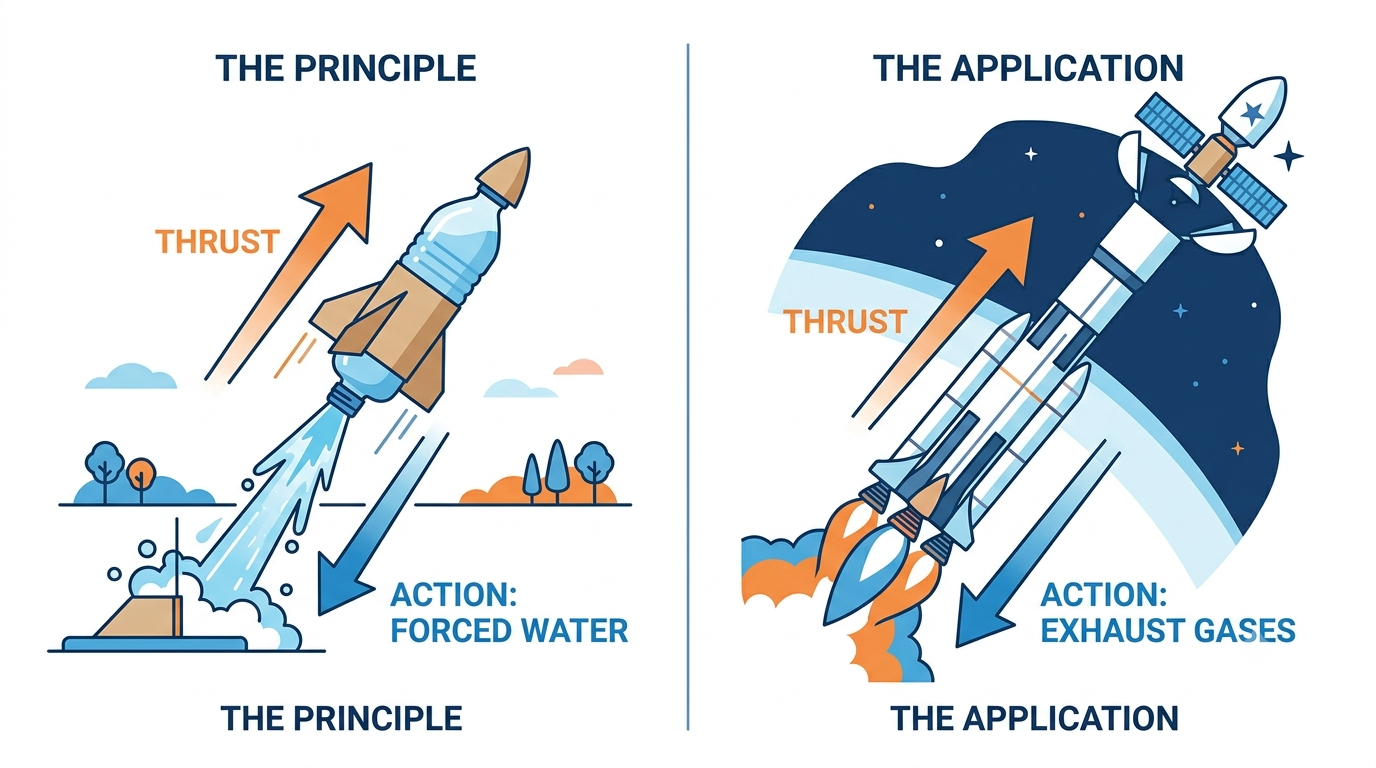
A basic water-bottle model rocket works identically. Fill the bottle partway with water, pump air in through the nozzle to build up pressure, then release the clamp. The pressurized air forces the water out downward at high speed, and the bottle shoots upward. This is Newton’s third law in action: every action has an equal and opposite reaction. The air and water rushing downward (the action) create an equal and opposite upward push (the reaction) — this upward push is called thrust.
Real rockets scale up the same idea using burning fuel instead of compressed air. As fuel burns and shoots out of the rocket’s base at extremely high speed, the resulting thrust builds until it exceeds the rocket’s own weight — and only then does it lift off the launch pad.


A Short History of Rockets: From Diwali Fireworks to War Machines
Rockets are a lot older than space travel. Historical records point to China developing the earliest rockets more than 800 years ago, originally intended purely for celebration — not unlike the fireworks rockets still launched during Diwali today. By 1232 AD, though, these same rockets were being modified and aimed at enemy forces during battle, turning a festive invention into a weapon.
The idea traveled and evolved — in the 18th century, Mysore’s ruler famously equipped his army with iron-cased rockets, an early and effective battlefield weapon in Indian history. Centuries later, during World War II, Nazi Germany’s scientists applied the same core principle to build long-range missiles. That military rocket technology eventually became the basis for the peaceful, if enormously more sophisticated, satellite-launch vehicles used today.
Why Don’t Satellites Fall Back to Earth?
Getting a rocket off the ground only solves half the problem — a satellite still has to stay up there without an engine constantly running. The answer comes from a thought experiment Isaac Newton described centuries before the first satellite ever flew.
Imagine standing on an impossibly tall mountain and firing a cannonball (A) horizontally. Gravity pulls it down, so it lands somewhere in front of the mountain. Fire another cannonball (B) with more gunpowder, and it travels faster — landing farther away, but still falling to the ground eventually. Newton’s insight was that if you kept increasing that firing speed, at some point the cannonball (E) would be falling toward the Earth’s curved surface at exactly the rate the Earth curves away beneath it. It would never actually hit the ground — it would just keep falling around the planet, forever tracing a circle. That speed is called orbital velocity.


This is precisely how satellites work. Launch one too slowly, and Earth’s gravity pulls it straight back down. Launch it at the correct orbital velocity, and the forward motion and the downward pull of gravity balance perfectly, keeping it in a stable path around the Earth. Launch it far too fast, and it overcomes gravity entirely and escapes into space rather than orbiting at all.
Types of Satellite Orbits: Polar, LEO, MEO, GSO, and GEO
Not every satellite orbits at the same height, because different jobs need different vantage points.
- Polar Orbit — roughly within 1,000 km of Earth’s surface, passing near the poles. Used heavily for climate study, geography, and environmental monitoring.
- LEO (Low Earth Orbit) — roughly 1,000–2,000 km up. Ideal for communication and remote sensing.
- MEO (Medium Earth Orbit) — roughly 2,000–36,000 km up. This is where navigation and GPS-type positioning satellites live.
- GSO (Geosynchronous Orbit) — around 36,000 km up, completing exactly one orbit per day, matching Earth’s rotation.
- GEO (Geostationary Orbit) — also about 36,000 km up and completing one orbit per day, but specifically aligned directly over the equator. Because it moves in perfect step with Earth’s rotation, a GEO satellite appears fixed in the same spot in the sky when viewed from the ground — unlike a general GSO satellite, which can be inclined and will appear to drift slightly. Both GSO and GEO satellites are heavily used for telecommunications, broadcasting, and weather monitoring.

Matching Launch Vehicles to Orbits: PSLV vs GSLV
The choice of orbit even decides which rocket gets used. Polar, LEO, and MEO satellites sit relatively close to Earth and carry comparatively lighter payloads, so India launches these using the PSLV (Polar Satellite Launch Vehicle). Satellites destined for the much more distant GSO or GEO orbits are heavier and need considerably more lifting power to reach that altitude, which is why India uses the GSLV (Geosynchronous Satellite Launch Vehicle) for these missions instead.
Real-Life Impact: GPS, Communication, and the Kargil War Lesson
It’s easy to underestimate how much ordinary life depends on satellites already quietly working overhead — phone calls, online food and ride-hailing app locations, live television, and weather forecasting all rely on satellite infrastructure most people never think about.
There’s also a sobering example of what happens without them. During the 1999 Kargil conflict, Indian forces needed to locate enemy positions across difficult, mountainous terrain. At the time, India had no GPS satellite system of its own and reportedly requested location data from the United States’ GPS network — a request that wasn’t granted. Indian forces ultimately won the conflict, but without that satellite support, at significant additional difficulty and cost. That experience became a major driver behind India later developing its own independent satellite systems, including dedicated navigation satellites like NavIC, precisely so the country would never again depend on another nation’s satellites during a crisis.
Common Misconceptions
A common misunderstanding is that satellites need engines constantly firing to “hold themselves up” — in reality, once a satellite reaches the correct orbital velocity, gravity and forward motion balance on their own, and no continuous thrust is needed to stay in orbit. Another common mix-up is treating “geosynchronous” and “geostationary” as identical terms; all geostationary satellites are geosynchronous, but not all geosynchronous satellites are geostationary, since only equatorial ones stay fixed over one spot.
Interesting Facts
- The Moon technically qualifies as Earth’s natural satellite, using the exact same orbital-velocity balance that keeps artificial satellites up.
- A satellite launched even slightly below its required orbital velocity will fall back to Earth, while one launched too fast escapes Earth’s gravity entirely.
- India’s Aryabhata satellite, launched in 1975, was the country’s first, well before India had developed the dedicated launch vehicles and navigation systems it uses today.
Comparison Table
| Orbit Type | Approx. Altitude | Primary Use | Launch Vehicle (India) |
|---|---|---|---|
| Polar Orbit | ~1,000 km | Climate, geography, environment monitoring | PSLV |
| LEO (Low Earth Orbit) | ~1,000–2,000 km | Communication, remote sensing | PSLV |
| MEO (Medium Earth Orbit) | ~2,000–36,000 km | Navigation, GPS-type positioning | PSLV |
| GSO (Geosynchronous Orbit) | ~36,000 km | Telecommunications, broadcasting, weather | GSLV |
| GEO (Geostationary Orbit) | ~36,000 km (equatorial) | Telecommunications, broadcasting, weather (appears fixed) | GSLV |
FAQ Section
Q1. How do satellites stay in orbit? Satellites stay in orbit by traveling at a precise orbital velocity, where Earth’s gravity pulls them into a curved path fast enough that they continuously “fall” around the planet instead of falling onto it.
Q2. What physics law explains how rockets launch? Newton’s third law — every action has an equal and opposite reaction — explains rocket thrust: exhaust pushed downward creates an equal upward force that lifts the rocket.
Q3. What happens if a satellite is launched too slowly? If a satellite’s launch velocity is below the required orbital velocity, Earth’s gravity pulls it back down before it can establish a stable orbit.
Q4. What is the difference between GSO and GEO? GEO is a specific type of GSO that orbits directly above the equator, making it appear fixed in the sky from Earth; other GSO satellites can be inclined and appear to drift.
Q5. What are the main types of satellite orbits? The main types are Polar Orbit, Low Earth Orbit (LEO), Medium Earth Orbit (MEO), Geosynchronous Orbit (GSO), and Geostationary Orbit (GEO), each suited to different uses.
Q6. Which rocket does India use to launch satellites? India uses the PSLV for lighter satellites in Polar, LEO, and MEO orbits, and the GSLV for heavier satellites headed to GSO or GEO.
Q7. Is the Moon a satellite? Yes — the Moon is Earth’s natural satellite because it revolves around the Earth, following the same orbital-velocity balance as artificial satellites.
Q8. Why did India need its own satellite systems? Events like the 1999 Kargil conflict highlighted the risks of depending on another country’s satellite systems during a crisis, driving India to develop independent systems like NavIC.
Q9. What do satellites actually do for everyday life? Satellites support phone communication, GPS navigation, ride-hailing and delivery app location tracking, live television, and weather forecasting.
Q10. Do satellites need engines to stay in orbit? No — once launched at the correct orbital velocity, a satellite’s forward motion and Earth’s gravity balance naturally, without needing continuous engine thrust.
Summary
Getting a satellite into space is really two separate physics problems solved back to back. Newton’s third law explains the thrust that lifts a rocket off the ground — the same principle at work in a simple balloon or bottle rocket. Once in space, Newton’s cannonball thought experiment explains why a satellite launched at exactly the right orbital velocity keeps circling the Earth instead of falling to it. Different jobs call for different orbits — Polar, LEO, MEO, GSO, and GEO — each matched to a suitable launch vehicle like India’s PSLV or GSLV.
Conclusion
The next time you look up and spot a satellite passing overhead, you’ll know it isn’t hanging there by magic — it’s obeying the same two laws of motion as a balloon flying across a room. If this connected some dots for you, the next LIFE Academy video dives into the specific rockets India has built to launch these satellites — check the video below, and stay tuned for that one.
External References
- NASA — “What Is a Satellite?” (learning resource for students)
- https://www.youtube.com/watch?v=yKWIQjceQl8
- NCERT Class 9/10 Science — Chapter on Gravitation
- Encyclopaedia Britannica — entries on “Satellite” and “Geostationary orbit”
Leave a Reply